Hello, it’s a great day to start a project.
Granite, by its very nature, transforms the kitchen countertop into an architectural feature in its own right, both functional and deeply rooted in the material.

Text: Marie Charles Pelletier
Granite has long been established as a durable material and the work surface of choice in kitchen design. It naturally acts as a material anchor, a piece of continuity that supports the rhythm of everyday life and fits into a long-term perspective rather than simply following a trend.
This thousand-year-old natural stone is known for its density, depth, and expressiveness, qualities that give it a strong visual presence. Each slab, with its veins and variations in colour, reminds us that the material carries a history within it, a presence that goes beyond simple utility. At Ateliers Jacob, questions of functionality, consistency, and longevity guide every project. Granite embodies a structuring choice: an element that organizes space and stands the test of time without losing its relevance.
The following sections explore the different ways in which stone can be used in the kitchen, the finishes available, and a few maintenance considerations that influence the experience over time. These elements provide a better understanding of how to integrate this stone into a kitchen project and get the most out of it.

Granite stands out first and foremost for its uniqueness. Each slab, with its veins and colour variations, reminds us that the material has a history, a presence that goes beyond mere utility. This uniqueness, specific to natural materials, contrasts with uniform, standardized surfaces and gives character to the space, adding an organic dimension that synthetic materials cannot reproduce. It also offers a wide range of colours and textures, making it easy to harmonize with the kitchen’s overall design.
Beyond aesthetics, granite’s geological formation gives it a density and strength that make it a particularly durable material. Heat-resistant and able to withstand repeated use, it is an ideal work surface for the busy rhythm of everyday kitchen life.
Its stain resistance also makes it a good choice, provided the countertop is properly sealed. Since granite is a naturally porous stone, the sealant acts as a protective barrier that facilitates maintenance and limits the absorption of liquids that could leave marks. Regular maintenance of the sealant is therefore part of the countertop’s life cycle, a simple gesture that ensures its longevity and reflects the care given to everyday objects.


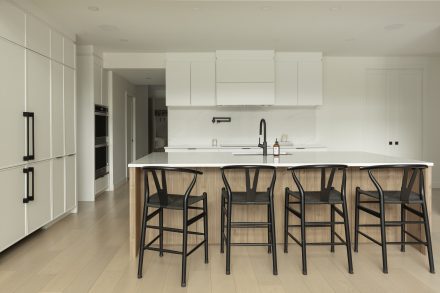
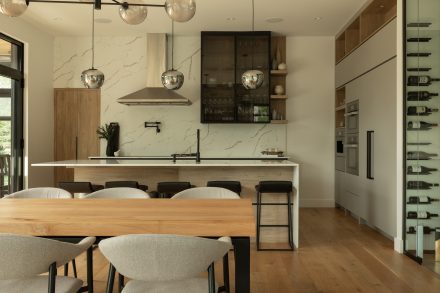
In a kitchen project, granite can play a structuring role by creating visual continuity between different elements. Using the same stone for the countertop and backsplash, for example, creates a consistent visual effect and reinforces the overall coherence.
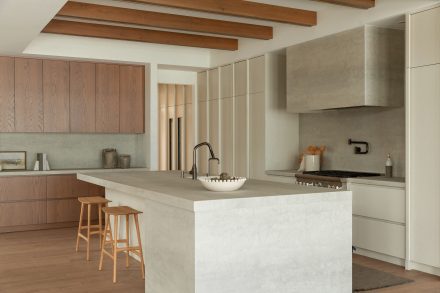
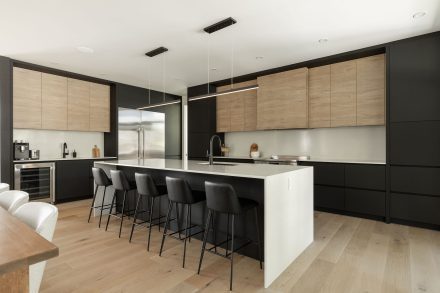
This continuity can also be achieved by using a waterfall edge on an island, where the stone extends vertically to the floor. The waterfall edge accentuates the presence of the material and can give the space a sculptural dimension, provided it is properly sealed.
The choice of finish also influences maintenance in these configurations.
A polished, smoother surface is better suited to this type of vertical application. Textured finishes, on the other hand, may require more attentive maintenance to prevent residue from accumulating in the stone’s relief.

Granite can be worked in different ways, each of which alters its appearance and texture. The choice of finish plays a decisive role in how the material is experienced.
The most common finish, polished, gives granite a shiny, smooth appearance that highlights the stone’s veins and nuances while making it easy to maintain. This type of finish makes it particularly suitable for vertical applications, such as waterfall countertops.
The honed finish, on the other hand, has a matte, less reflective appearance, offering a more understated aesthetic. Depending on the colour of the granite chosen, however, it may be more susceptible to visible wear marks.
Finally, the leathered finish combines polishing, texturing, and brushing to give the granite a slight relief. Its subtly textured surface hides certain micro-marks and gives the countertop a distinct tactile dimension.
Each finish responds to the needs and preferences of each individual, demonstrating the versatility of granite and its ability to integrate into all kinds of kitchen projects.

Beyond the choice of stone itself, certain technical details influence the overall perception. The edge profile, that is, the shape of the edge, influences the perception of the countertop. A straight edge highlights the precision of the design and reinforces a contemporary aesthetic, while a rounded profile softens the transition between the surface and the surrounding space.
The application of sealant also plays a fundamental role in the durability of the stone and how it evolves over the years. A well-sealed countertop is more resistant to stains and limits liquid absorption even under heavy daily use. The same goes for maintenance, as the use of mild, non-acidic cleaning products helps maintain the integrity of the surface. These simple steps help preserve the natural qualities of granite and extend its lifespan in daily use.

Choosing a granite countertop means choosing a material that stands the test of time.
The mere presence of this natural stone creates a sense of stability in any space. With its range of colours, finishes, and applications, this countertop choice blends naturally into many environments and complements everyday life. Granite is not a temporary solution, but a lasting answer to everyday demands. Its finish, maintenance, and design details influence the experience we have with it, reminding us that design always arises from the encounter between material and use.
To compare with other materials or explore different possibilities, the Ateliers Jacob countertop guide offers additional information and practical guidance.